
We've discussed timing the pitcher and creating the gap. In our final installment on stealing 3rd, let's talk about the catcher.
The catcher
When you deem the timing is right to steal third base, look to the catcher before bolting. How strong is the catcher's arm? What pitch is the catcher likely to call (easier to steal on an offspeed pitch)? And....where is the catcher setting up? If the catcher is setting up inside on a righthanded hitter, it could be more difficult for him to get a throw off as the batter will obstruct the throwing lane to 3rd. If there is a lefthanded batter at the plate, it really opens up the throwing lane for the catcher.
Lots to think about. As you play more, you will be able to collect all this information in your head in a matter of seconds and make a good decision.
8/20/08
Stealing 3rd, Part 3


8/18/08
Stealing 3rd, Part 2

In our first installment on stealing 3rd, we spoke about timing the pitcher. In Part 2, we will talk about creating a gap.
Create a gap
By stealing 3rd base, one thing you are doing is opening up a larger hole on the left side of the infield, as the 3rd baseman needs to vacate his position to cover 3rd base.
There are several situations where your hitter is more likely to hit that gap:
1. The hitter has a tendency to hit the ball that way.
2. The pitcher is likely to throw a ball that the batter can hit in that gap. (most often this will be a pitch middle/in to a righthanded hitter)
3. It's a hitter's count (1-0,2-0,2-1,3-1) when a hitter is in an aggressive mode at the plate.
On the flip side
If your team is in the field, you might consider holding the 3rd baseman in position and conceding 3rd base. You would probably only do this when there are 2 outs and you believe there is a high likelihood that the batter will hit the ball in that gap.
8/13/08
Stealing 3rd, Part 1
Stealing 3rd base is something that amateur and scholastic teams should be doing more often. It's all about finding the right opportunities. Consider this posting the first in a three part series about stealing 3rd.
Timing is Everything
Steal on a pitcher who doesn't change his timing to the plate. By studying the pitcher's tendencies, a runner at 2nd can get a huge jump. Look for a few things:
1. Observe how many times the pitcher looks at the runner before starting his delivery to the plate
2. Count the seconds from the pitcher's set position to the start of his motion.
3. Look for a movement the pitcher makes that jumpstarts his motion. Sometimes a pitcher will tuck his chin or bob his head slightly.
The effectiveness of this approach is increased even more when the 2nd baseman and shortstop are not paying much attention to the runner at 2nd.
Rule of Thumb: Don't make the 3rd out trying to steal third. Most likely, you will score from 2nd base on a 2-out base hit anyways so the reward of getting to 3rd is not nearly as great as when there are less than 2 outs. I'm not saying not to steal 3rd with 2 outs. I'm just saying that if you go, you better be safe! If you consider it somewhat of a risk, steal with 0 or 1 outs. Then, you have the added reward of being able to score from 3rd on a sac fly or infield grounder.

6/20/08
Casper the Friendly Basecoach
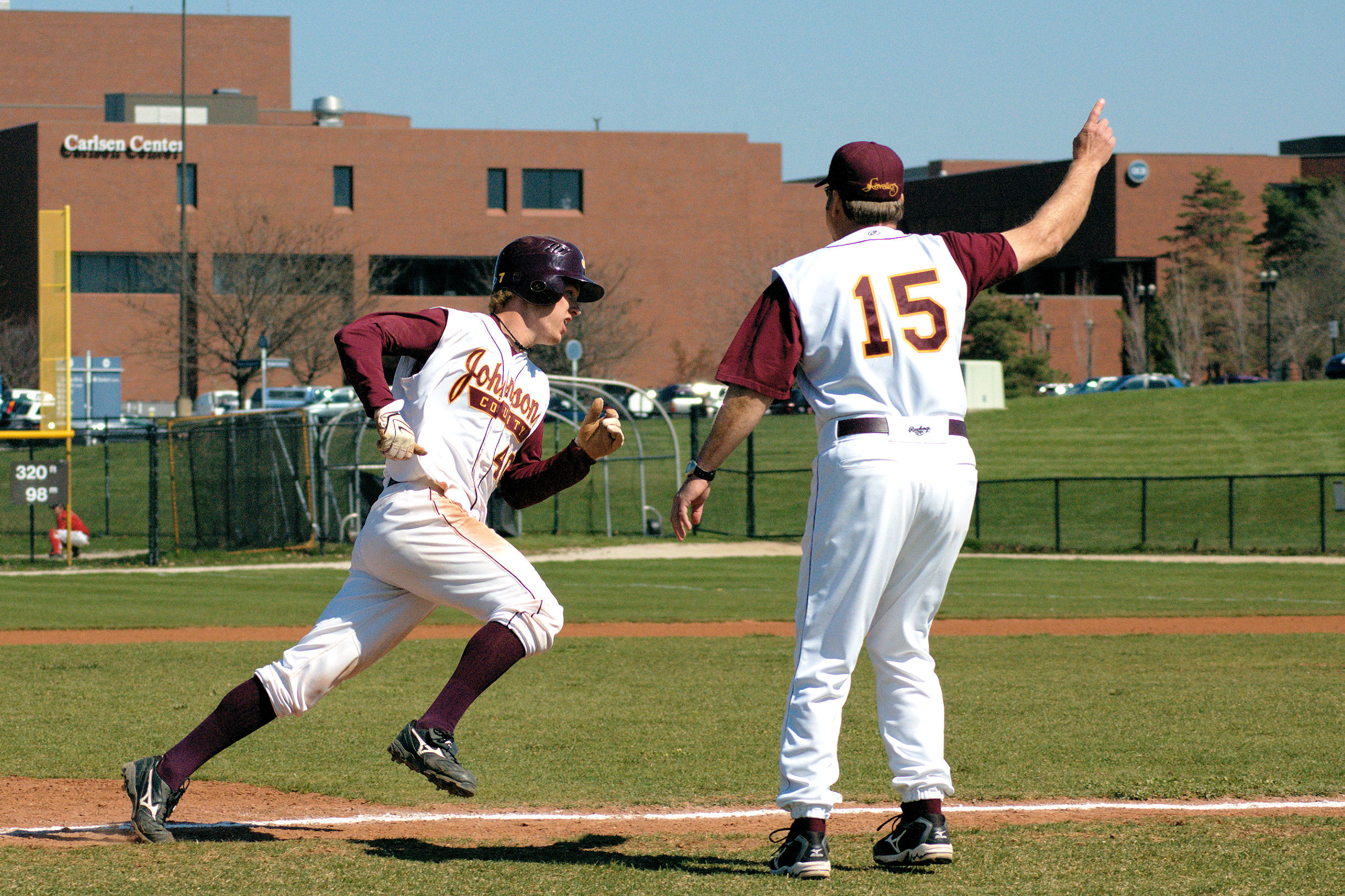
This post is dedicated to those under-appreciated, underrated base coaches out there. Can you think of another sport where players look to coaches for guidance in the heat of a play? Imagine Doc Rivers standing in the paint and telling KG to take it to the hoop. Imagine Bill Belichek standing behind Tom Brady and whispering in his ear, "Check out Randy cutting across the middle." It doesn't happen. In baseball, it does. And ironically, basecoaches all to often take their jobs for granted. Here are 5 ways that basecoaches can do a better job:
1. Stay on your toes. Your attention and intensity should be equal to or greater than that of the baserunners.
2. Be a broken record. You can't be too annoying when coaching the bases. Remind baserunners of the number of outs and other situational cues. Use a combination of verbal reminders and hand signals.
3. Know the signs. It sounds stupid but often times the signs are coming from the bench and the basecoaches will tune them out.
4. Be a student. Study tendencies of the defense. You could pick up on a weak arm, lack of concentration, or other observations that can influence your decisions.
Ok....these tips are too vague for you? Here's some candy:
5. Remind your baserunners of things like these:
-Let the line drive go through.
-Break up two.
-Pitcher is coming with a breaking ball, anticipate a ball in the dirt.
-Don't forget...there's a runner in front of you.
-1st baseman is playing behind the bag
-Infielders are playing back
-Same rhythm (i.e. the pitcher is not changing up his timing)
6/2/08
Crossed Signals
The following situation took place in the Belmont/Dracut State tournament game:
Runners on 1st and 3rd. 1 out. The steal sign is given to the runner on 1st base. The runner on 3rd base mistakenly takes off for home, thinking the steal sign was intended for him. The pitcher steps off the mound, throws to the catcher, and the runner is thrown out at the plate.
Question: If the batter had thrown his bat at the ball and made contact, what would the call have been? It's clearly interference on the batter, given that it was not a pitch. Is the batter called out and the runner sent back to third? If this is the case, it would have been the best move for the batter if he believed the runner would be out at the plate. 1st and 3rd with 2 outs beats having a runner on 1st with 2 outs.

4/4/08
The Break Up
In the Pawtucket Red Sox/Indianapolis Indians game last night, the following situation took place:
Runner on 1st base, 0 outs. Ground ball to the 2nd baseman, fielded in the baseline before the runner reaches him. The runner evades the tag by shifting his course out of the baseline. The 2nd baseman throws to 1st for the out. The runner who leaves the baseline is also called out.
You are the runner
As the runner in this situation, I believe you should lower your body to the ground as you approach the fielder. By doing this, the fielder now has to reach to tag you before throwing to first. You're buying the hitter more time to reach 1st base safely. If you try to avoid the tag, you could be called for running out of the baseline. If you stop, you will likely become the back end out of the double play.
You are the fielder
Resist the temptation to tag a baserunner who is out of reach. Take the out at first and have confidence the 1st baseman will finish the double play with a good throw to the shortstop covering 2nd base.
Are there other things to consider in this situation?
3/30/08
I Saw The Sign
There are three important things when you think about signs.
1. Know the signs
2. Know when to look for the signs
3. Execute on the signs
Know the Signs
I cannot stress enough the importance of knowing your signs. Coaches should review signs before every game. This will make the signs more memorable and your players accountable. Players-- ask about signs if you forget them.
Know when to look
Know the situation and be thinking about what signs might be given. Whether you are the hitter, a runner, or a basecoach, you should anticipate possible scenarios and look carefully for the signs. If there are runners on 1st and 2nd base with no outs in a close game, you best be looking for some signs!
Execute
It goes without saying that we want to execute on a sign whether it be getting a bunt down or stealing a base safely. It is equally as important for the other players to do their job. This could mean swinging over a strike when your teammate is stealing a base. Knowing what your teammates are trying to do will enable you to make the best decisions on the diamond.
How do you think about signs?

3/27/08
Wind It Up
As a baserunner, keep your eye out for a pitcher who goes into a daze and pitches from the wind-up when there is a base to be taken. In my amateur baseball league, I see this happen at least once a year.
I don't care if you run with a piano on your back or if you are the fastest runner on the team, a pitcher going into the wind-up is a license to steal. No sign needed. Once you see the pitcher's leg drop back (left leg for a righty, right leg for a lefty), take off!
Coach's Tip
You might think that this is a trivial point, and a waste of time in terms of teaching points for your team. There are lots of fine points like this one in baseball. They all add up. Covering them could mean the difference in close games.

Special K
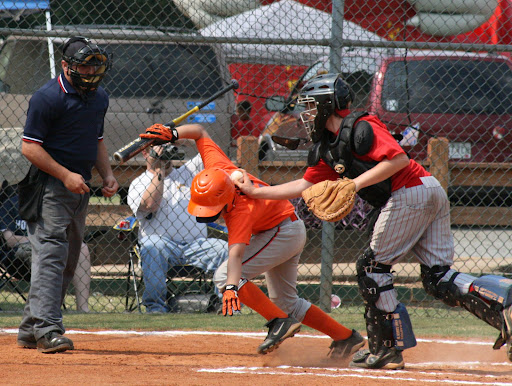
Let's take a look at a situation where a third strike is dropped by the catcher.
The Defense--Back That Bag Up
The ball often goes to the backstop in this scenario.
The 2nd baseman should absolutely back up that throw from the catcher. It's a long throw, it's rushed, and not typically practiced. Note: The rightfielder should also sprint to the line to back up that throw.
The Offense--Make The Most Of It
The baserunner can only run to first base if it's 1. unoccupied or 2. there are 2 outs. This is a rule that is often misunderstood.
The baserunner must stay within the running lane or could be called for interference if he obstructs the catcher's throw. Nice fields have this lane marked. Most fields don't. It's up to the umpire's discretion.
As a baserunner, there is nothing wrong with running to 1st when it is occupied in this situation. Often times it will cause confusion for the defense.
Trivia
What is the highest # of strikeouts a pitcher can have in an inning?
3/21/08
The 45 degree rule
Running on a lefty pitcher is one of the toughest tasks for a baserunner. There are many aspects to studying a lefty pitcher. Here I will focus on a fine point.
We know that a lefty pitcher must follow the 45 degree rule. Once the pitcher has committed to the plate (determined by his right leg having traveled 45 degrees from the line connecting his left leg and 1st base) he no longer is allowed to throw to 1st base.
Conservative baserunners will wait until a lefty pitcher has made this commitment to the plate. Be wary of an exception to the rule. If a pitcher's right leg crosses his left, he has committed himself to the plate. In this instance, a baserunner can often get a great jump on a lefty.
Coach's Tip
Stress the importance of studying a lefty's move. Players should do this on the bench so they are best prepared when they are in a live situation on first base.

3/10/08
Pick & Go
Runner on 1st base. Steal is on.
You're on first base with the steal sign. You take off a little bit too early and the pitcher fires over to 1st base. What should you do?
Don't stop! Run hard and run directly at the middle infielder covering 2nd base to put yourself in the throwing lane. More often than not, you will be safe at 2nd base. By taking this approach, you will force the 1st baseman to make a perfect throw.
Coach's Tip
With a righthanded pitcher, runners should not be leaving before the pitcher has committed himself to the plate. However, you might consider going on a lefty pitcher's 1st move because it is much harder to swap a base off a lefty. If you include the first move steal in your strategy, be sure to stress the Pick & Go approach.


